AI Voice Agents for Small Businesses: Never Miss a Call
- Chris Riser

- Feb 10
- 10 min read

Introduction
It's 7 PM on a Thursday, and a ready-to-buy customer calls your business with a quick question. Your team is off the clock, the call hits voicemail, and the customer moves on to a competitor who answers immediately.

For many owners, that scenario represents a silent leak in the sales funnel: missed calls become missed revenue. Whether it's a new lead exploring your services, a shopper finalizing a decision, or a customer needing help after purchase, responsiveness often determines the outcome.
AI voice agents for small businesses are changing this equation. These intelligent phone systems can answer calls 24/7, understand what callers need, provide accurate information, and route every interaction to a clear next step—without requiring a human to be on standby.
In this guide, you'll discover how AI voice agents work, where they create the most impact in your sales funnel, how to implement them confidently, and how to measure ROI so the investment proves itself.
What Are AI Voice Agents for Small Businesses?
AI voice agents for small businesses are software assistants powered by conversational AI to handle natural, two-way phone conversations with callers. Unlike traditional phone trees ("Press 1 for hours, press 2 for billing"), these agents interpret what callers say, ask clarifying questions, and respond in real time.
How an AI voice agent works in plain English

Most modern voice AI agents combine several core components:
Speech-to-text (ASR): Converts a caller's voice into text reliably, even with background noise or accents.
Natural language understanding (NLU): Determines what the caller wants (intent) and identifies the details that matter (entities like dates, locations, or service types).
Reasoning and workflow logic: Decides the next action—provide information, ask a follow-up question, book an appointment, collect details, or transfer to your team.
Text-to-speech (TTS): Responds in a natural-sounding voice that puts callers at ease.
System integrations: Connects seamlessly to your calendar, CRM, order system, or support desk to take immediate action.
Because these systems integrate with your business tools, an AI agent can do far more than just talk. It can schedule appointments in real time, create leads in your CRM, send confirmation texts, or transfer callers to the right team member with full context already captured.
Why the timing is right: technology maturity meets affordability
Voice AI quality has improved dramatically over the past few years, backed by significant investment and real-world deployments across industries. For example, TechCrunch reported on major funding rounds that reflect growing confidence in voice technology. These advances benefit the entire market, pushing down costs and improving capabilities for small business users.
If you've had frustrating experiences with clunky phone systems in the past, here's the key difference: Today's AI voice agents are built for conversation and measurable outcomes, not just menu navigation.
How AI Voice Agents Strengthen Your Sales Funnel

Your sales funnel represents the entire customer journey—from first awareness through purchase and beyond. AI voice agents for small businesses keep your business actively present at every stage, including evenings, weekends, and during high-volume periods when your team can't answer every call.
Top of funnel: Capture and qualify leads instantly
When a prospect calls after seeing an ad, Google search result, or receiving a referral, speed and first impressions matter. A voice AI agent can:
Answer immediately—no hold music, no voicemail delays
Collect essential contact details and understand their need
Ask qualifying questions (budget, timeline, service area, urgency)
Route to the appropriate next step: schedule a consultation, send information, or connect to your sales team
This is where 24/7 call answering typically delivers the fastest payback—by recovering leads that would otherwise be lost to your competition.
Middle of funnel: Consistent follow-up and objection handling
Most prospects need multiple touchpoints before deciding. Human teams struggle with consistent follow-up because competing priorities pull focus. A conversational AI agent can handle routine outreach and address common questions:
"What does your service cost?"
"Do you serve my area?"
"What's your next available time slot?"
"Can you send me that information via text?"
When connected to your CRM, it can personalize conversations based on previous interactions—referencing a quote sent last week or acknowledging a prior concern. That transforms the tool from a question-answerer into an active funnel-progressor.
Bottom of funnel: Reduce friction at the moment of decision
Friction kills deals when customers are ready to commit. AI voice agents for small businesses minimize friction by:
Confirming pricing, policies, and deliverables clearly
Walking through next steps (what to prepare, when to expect contact)
Securely collecting the details needed to finalize orders or bookings
Sending instant confirmation via SMS and email
Post-purchase: Support, retention, and advocacy
The customer relationship doesn't end at purchase—it evolves. Voice agents can support existing customers with:
Order or project status updates
Appointment reminders and rescheduling
Frequently asked questions and basic troubleshooting
Automated review requests after successful completion
To amplify this strategy further, connect voice agents to your broader automation ecosystem. See AI Sales and Marketing Systems for a complete blueprint linking phone, SMS, email, and CRM into a unified customer journey.
Key Benefits of AI Voice Agents for Small Businesses

The core advantage is straightforward: AI voice agents for small businesses enable you to respond immediately and consistently, which directly improves lead conversion, customer satisfaction, and revenue.
Never miss another opportunity
A single human receptionist can handle one call at a time. A voice AI agent can process multiple simultaneous calls, eliminating:
Busy signals that frustrate callers
Long hold times that encourage hang-ups
After-hours voicemail that feels like rejection
For owners juggling sales, operations, and service delivery, this operational relief is often transformative.
Higher-quality leads (not just higher quantity)
Because an AI phone answering service asks structured questions consistently, you collect cleaner data:
Why they're calling
Their location or service area
Their preferred contact time
Budget range (when relevant)
Your sales team then focuses on genuinely qualified opportunities instead of sorting through noise.
Consistent, professional customer experience
Customers may resist being "sold," but they appreciate being helped. When your AI agent is trained on your policies and service details, customers experience:
Reliable, accurate answers every time
Clear next steps and expectations
Multilingual support (when enabled)
Operational efficiency without hiring call center staff
Instead of paying for full-time reception coverage, AI voice agents for small businesses automate repetitive inquiries—hours of operation, directions, service pricing, appointment changes—so your team dedicates time to complex issues and relationship-building.
Data and insights you can act on immediately
Every call generates structured data you can analyze:
What callers ask about most (revealing content gaps)
Missed-call reduction metrics
Conversion rates by source or campaign
Peak call times (informing staffing decisions)
Trends in objections or concerns
For deeper guidance on AI Voice Follow-Up Automation, explore AI Follow-Up Automation: Email, SMS & Voice Sequences That Convert
Real-World Use Cases Across Industries
AI voice agents for small businesses are already deployed across sectors because phone communication is universal—and poor responsiveness is expensive no matter the industry.
Professional services (law, accounting, consulting)
Common workflows include:
Initial client intake and consultation scheduling
Collecting project scope and background details
Policy FAQs and timeline expectations
Appointment confirmations and prep reminders
Home services (HVAC, plumbing, electrical)
This sector benefits significantly from 24/7 call answering because emergencies don't follow business hours. A voice AI agent can:
Capture urgent service details immediately
Estimate arrival windows and next availability
Confirm the booking with address and phone number
Escalate genuine emergencies to on-call technicians
Retail and e-commerce
Conversational AI agents handle:
Product questions and real-time availability
Store hours, location directions, and curbside pickup
Order status inquiries
Returns and exchange workflows
Healthcare and wellness (dental, therapy, spas, clinics)
For scheduling-intensive businesses, AI voice agents can:
Book, confirm, reschedule, and cancel appointments
Send preparation instructions and reminder notifications
Answer common policy and insurance questions
Note: Healthcare deployments require compliance with regulations like HIPAA (US). Choose platforms and configurations that align with your legal obligations.
Real estate
Speed-to-lead is everything in real estate. A voice AI agent responds instantly to property inquiries, qualifies the prospect, and books showings—all before manual follow-up is possible.
Financial services and lending (where permitted)
Security and verified workflows are paramount in financial services. FinTech Futures reported on Veritus raising seed funding specifically for voice-first agents handling follow-ups and payment conversations for lenders. Even if lending isn't your business, the principle is clear: security-first voice AI is becoming standard practice.
Implementation Guide: Deploy with Confidence
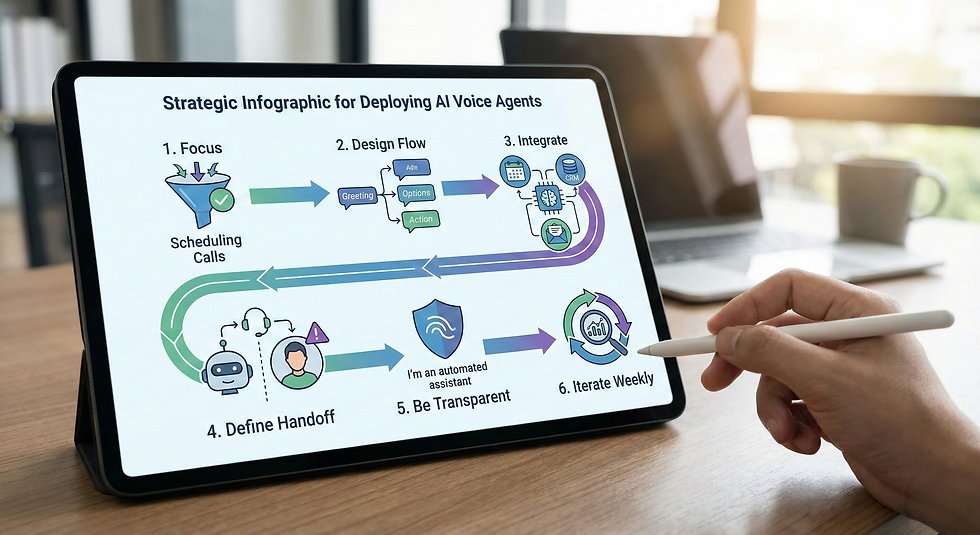
Rolling out AI voice agents for small businesses doesn't require complexity, but it does require strategy. The best results come from starting focused, validating ROI, then scaling.
Step 1: Choose one high-volume, low-risk call type
Ideal starting points include:
After-hours call handling
Appointment scheduling and rescheduling
Hours, location, and basic service questions
Pricing ranges and service area verification
Avoid starting with edge cases like billing disputes or complaints until you've built confidence in the system.
Step 2: Design conversational call flows (not scripts)
Your AI voice agent should feel like a helpful colleague, not an interrogation. Build flows around:
A warm greeting that sets expectations
Two to four key questions that move toward resolution
Clear options for next steps: scheduling, information delivery, or human transfer
Example flow:
"Hi! Thanks for calling [Business]. How can I help you today?"
"Are you looking to schedule an appointment or get information?"
"What's the best ZIP code to help me route this for you?"
"Perfect—let me get you booked. What day works best?"
"All set! You'll receive a confirmation text in 30 seconds."
Step 3: Integrate systems that unlock real ROI
A voice AI agent becomes significantly more powerful when it can take action. Prioritize integrations with:
Calendar systems (Google Calendar, Outlook) for live scheduling
CRM platforms (HubSpot, Salesforce, etc.) for lead creation and follow-up
Help desk software (Zendesk, Freshdesk) for ticket creation
Payment systems (if appropriate and compliant)
Step 4: Set clear handoff rules for human agents
Even sophisticated AI will encounter scenarios requiring human judgment. Define escalation triggers such as:
Caller requests a manager or specific team member
Sensitive account or billing matters arise
Emotional escalation is detected
AI confidence score falls below your threshold
When transferring, pass all context: what the caller wanted, what was resolved, and what's pending.
Step 5: Be transparent about automation (and protect your brand)
Acceptance is usually high when the agent is helpful and upfront. Consider a simple introduction:
"Hi—this is the automated assistant for [Business]. I can help you schedule an appointment or answer common questions. Would you like to proceed?"
Trust also depends on privacy. Limit sensitive data collection, mask personal information when possible, and follow data retention best practices.
Step 6: Iterate weekly during your first month
AI voice agents for small businesses are not "set and forget." During the first 30 days, review:
Call transcripts for misunderstandings or confusion
Drop-off points where callers disconnect
Frequently asked questions missing from your knowledge base
Caller feedback on the experience
Small improvements at this stage compound rapidly.
Cost, ROI, and Measuring Success

The fastest way to justify AI voice agents for small businesses is connecting performance to metrics you already care about: leads captured, appointments booked, and revenue protected.
Typical cost structure
Pricing varies by platform and usage volume, but common models include:
Monthly platform subscription
Per-minute or per-call usage charges
Add-ons for integrations, additional phone numbers, or advanced analytics
Rather than focusing on absolute cost, compare it to the value of:
One additional booked appointment per week
A handful of recovered leads monthly
Reduced staff overtime and interruptions
Quick ROI calculation
Use this straightforward framework:
Missed calls per week × % qualified rate × Close rate × Average gross profit = Weekly profit lost
Then compare to your AI agent cost.
Example:
15 missed calls per week
40% are qualified leads
25% close rate
$300 average gross profit per sale
Result: $450 per week in recoverable revenue
Even recovering half of missed opportunities typically pays for the tool.
Key metrics to track in months 1–2
Monitor these consistently:
Answer rate: Total calls answered ÷ total calls received
After-hours conversions: Appointments or leads created outside business hours
Lead qualification rate: Calls that become genuine opportunities
Response time: Should approach instantaneous
Human handoff rate: High rates suggest workflow gaps
Customer satisfaction: Post-call sentiment scores (if available)
When evaluating a vendor or AI phone answering service, request to see dashboards tracking these metrics before committing.
FAQ: What Business Owners Want to Know
Will my customers be bothered by talking to an AI?
Most customers care more about speed and resolution than whether they're speaking to a human or AI. If your agent is transparent, genuinely helpful, and can quickly connect callers to a person when needed, acceptance is typically strong.
Can AI voice agents for small businesses sound natural?
Absolutely—voice quality has improved significantly. Still, test the system yourself on mobile and landline, in quiet and noisy settings, and with different accents or speech patterns to ensure it meets your standards.
What happens if the AI misunderstands a caller?
Build in guardrails:
Limit what the agent can promise (avoid commitments that require human approval)
Require confirmation for critical details (address, appointment time, name spelling)
Use handoff rules to escalate when confidence is low
Do I need to let go of my current receptionist?
Not at all. Many businesses use AI voice agents for small businesses to augment their team by covering:
After-hours calls
Overflow during peak times
Routine FAQs and scheduling
Your existing staff can then focus on complex calls and relationship-building.
Is it secure?
Security depends on your chosen platform and configuration. Select providers with strong security credentials, minimize sensitive data collection, and ensure your setup complies with any industry regulations that apply to your business.
The Future of Voice AI for Your Business
The next generation of AI voice agents for small businesses will evolve beyond simply "having conversations" toward orchestrating complete customer outcomes across your entire business.
Watch for progress in:
Deeper personalization: Agents adapting in real time based on customer history and preferences.
Proactive outreach: Helpful follow-ups that feel natural, not pushy—like appointment reminders and quote check-ins.
Multimodal experiences: Voice combined with text confirmations, clickable links, and even video when appropriate.
Broader automation: Voice agents coordinating seamlessly with your marketing, SMS, and CRM systems.
Industry partnerships continue validating the category. FinTech Magazine reported that Revolut partnered with ElevenLabs to deliver multilingual, 24/7 customer service at scale. While your business may not serve millions of customers, the underlying capabilities—instant response, multilingual support, and consistent workflows—apply directly to growing teams.
The competitive reality is becoming clear: as more businesses adopt voice AI, "We'll call you back tomorrow" becomes an increasingly expensive strategy.
Conclusion
AI voice agents for small businesses solve one of the most expensive operational gaps: missed calls that become lost revenue. By delivering 24/7 availability, consistent qualification, and immediate action, these tools transform your phone line from a bottleneck into a competitive advantage.
The technology is proven, affordable, and accessible. The question isn't whether voice AI will reshape customer communication—it's whether your business will lead or follow.
Start with one clear use case, measure the impact, and scale confidently. Your next customer is calling—make sure you're ready to answer.
Would you like me to help you brainstorm a specific "conversational flow" for your business to see how an agent might handle your most common calls?


Comments